
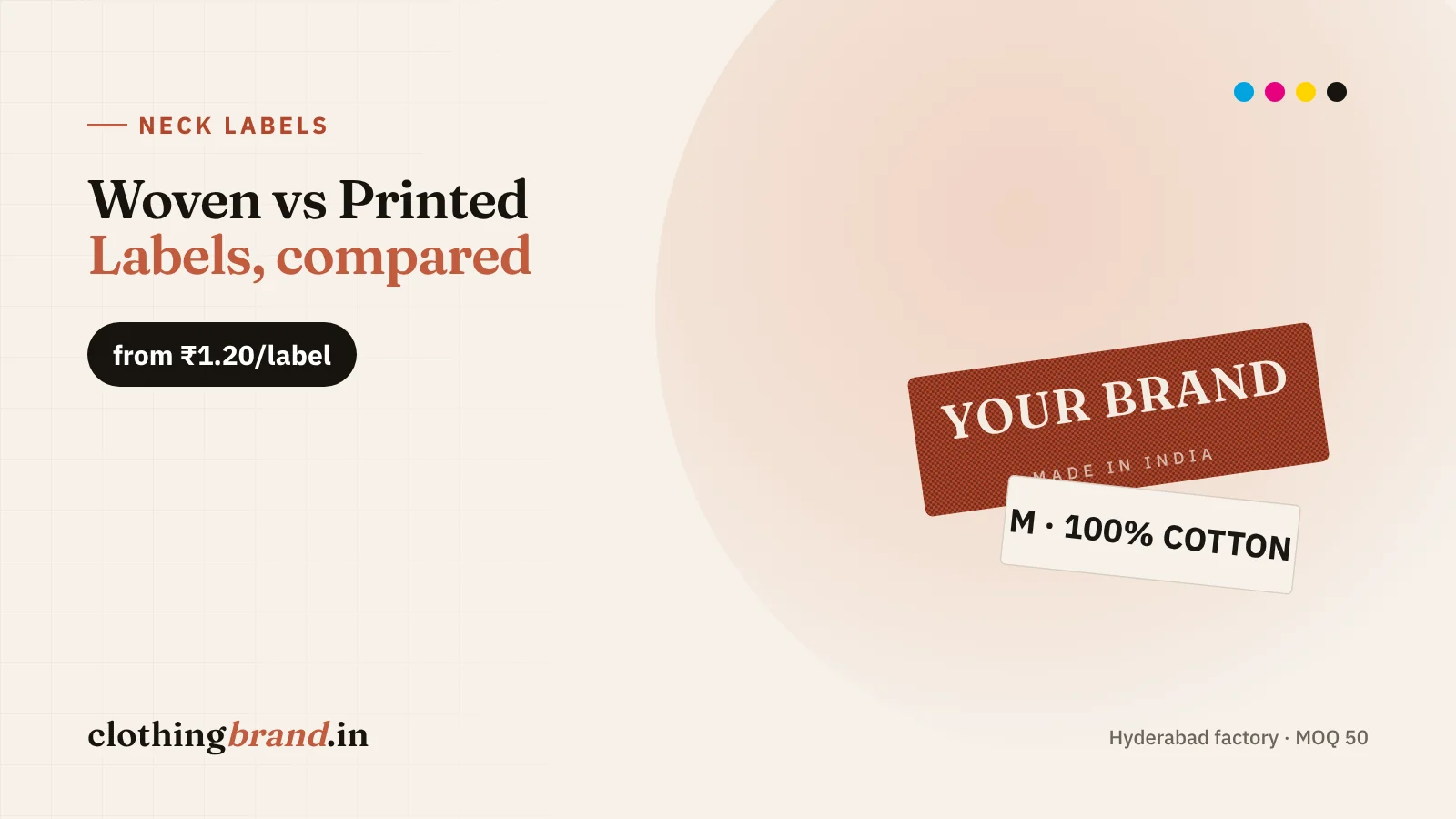
Quick answer: Choose a woven damask label if you want your brand to feel premium and last as long as the garment (₹1.80–₹4.20 a label). Choose a printed satin label if you need a lower cost, small text or a soft feel for kidswear (₹1.20–₹2.80). Choose a cotton tape label for an organic, earthy look (₹1.50–₹3.20). The minimum order is 500 labels.
Your neck label is the one piece of branding a customer sees every single time they wear your product. It is also what separates "a printed T-shirt" from "a brand" in a buyer's mind. Yet most first-time founders decide on labels at the last minute, from a WhatsApp photo, and regret it after the first wash.
Here is how the three main label types compare, what they really cost in India, and which folds and sizes work for T-shirts, hoodies and shirts.
The three label types
1. Woven damask labels
Your logo is woven into the label with fine polyester threads on a loom, like a tiny piece of fabric. Damask is the high-density weave used by most premium brands. Text stays sharp, the label holds its shape, and it never fades because the design is the thread.
- Feel: smooth, slightly firm, premium.
- Durability: outlasts the garment.
- Detail: very good. Text down to about 2 mm cap height.
- Colours: up to 6–8 thread colours.
2. Printed satin labels
Your design is printed onto a soft satin ribbon. It is the cheapest option and the softest against the skin, which is why kidswear and loungewear brands use it. Printed labels can carry more text (wash care, size, "Made in India") on one label.
- Feel: very soft, shiny.
- Durability: good, but ink can fade after many hot washes.
- Detail: excellent for small text.
3. Cotton tape labels
Printed on natural cotton tape. They feel matte and earthy, which suits organic, sustainable or handmade brands. They soften with every wash but can fray if cut without a fold.
Real prices per label in India
These are our per-label prices for a 50 × 15 mm label. Larger labels cost more: 60 × 20 mm is about 15% more, 70 × 25 mm about 30% more.
| Quantity | Woven damask | Printed satin | Cotton tape |
|---|---|---|---|
| 500 | ₹4.20 | ₹2.80 | ₹3.20 |
| 1,000 | ₹3.40 | ₹2.20 | ₹2.60 |
| 2,500 | ₹2.60 | ₹1.70 | ₹2.00 |
| 5,000 | ₹2.10 | ₹1.40 | ₹1.70 |
| 10,000 | ₹1.80 | ₹1.20 | ₹1.50 |
A loop fold adds about ₹0.20 a label. If you order garments from us, a woven label sewn in costs ₹4 per piece and a printed satin label ₹2.50, including stitching. You can design yours and see the live price on our neck label builder.
Which fold should you choose?
| Fold | What it looks like | Best for |
|---|---|---|
| End fold | Both short ends folded under and stitched flat | T-shirts and hoodies (most common) |
| Centre fold | Folded in half, stitched into the seam, shows front and back | Shirts, size or care on the back |
| Loop fold | Folded into a loop, stitched in the seam | Hanging loops, jackets, side seams |
| Straight cut | Flat, heat-cut edges, stitched on all sides | Hem tags, outside branding |
Which size?
- 50 × 15 mm: clean and minimal. Brand name only. Most streetwear tees.
- 60 × 20 mm: the safe default. Brand name plus a small mark or size.
- 70 × 25 mm: room for a logo, size and "Made in India". Hoodies and sweatshirts.
Tip: if your logo is wide and short, choose a wider label rather than shrinking the logo. Thin strokes under 0.5 mm disappear in weaving.
Woven or printed? Decide in 30 seconds
| If you… | Choose |
|---|---|
| Sell T-shirts above ₹699 | Woven damask |
| Make kidswear or loungewear | Printed satin |
| Need lots of small text on one label | Printed satin |
| Run an organic or sustainable brand | Cotton tape |
| Want the lowest cost per piece | Printed satin |
| Want the label to say "premium" | Woven damask |
Neck label vs printed neck (tagless)
Some brands skip the sewn label and print the brand and size inside the neck. It is comfortable and modern, but it feels less premium to most Indian buyers and is easy to copy. A good middle path is a printed inner neck for size and care plus a small woven brand label on the hem or sleeve.
What else should go on or with the label?
Under India's Legal Metrology (Packaged Commodities) rules, packaged garments sold to consumers need details such as the manufacturer or marketer name and address, the net quantity, the MRP and the month of manufacture. These usually go on the swing tag or the polybag sticker, not the neck label. Wash care and fibre content are best on a separate care label in the side seam. Ask your CA or compliance adviser to confirm the exact wording for your products.
Five label mistakes we see every month
- Ordering labels after the fabric is cut. Labels take 7–10 days. Order them with your sample.
- Using a tiny serif font. Thin serifs break up in weaving. Use a bolder weight.
- Scratchy edges. Ask for an end fold or a soft heat-cut edge, never a raw cut, on neck labels.
- Wrong colour contrast. Navy text on black looks great on screen and invisible in real life. Aim for strong contrast.
- Ordering exactly the garment quantity. Keep 5–10% spare for samples, replacements and reprints.
Our recommendation
For a first drop of 100–300 pieces, order 500 woven damask labels, 60 × 20 mm, end fold. It costs about ₹2,400, covers your first two or three drops, and makes even a ₹249 blank feel like a ₹999 product. Pair it with a proper sample check before bulk.
Frequently asked questions
What is the minimum order for woven labels in India?
Most label makers start at 500 to 1,000 labels per design. We start at 500 woven, printed satin or cotton tape labels.
Are woven labels better than printed labels?
Woven labels look more premium and outlast the garment, so most fashion brands use them. Printed satin labels are softer and cheaper, which suits kidswear and loungewear.
How much does a woven neck label cost in India?
From about ₹1.80 to ₹4.20 per label for a 50 × 15 mm woven damask label, depending on quantity. Larger sizes cost about 15–30% more.
What size should a T-shirt neck label be?
50 × 15 mm or 60 × 20 mm works for most T-shirts. Hoodies and sweatshirts often use 70 × 25 mm.
How long do labels take to make?
Usually 7–10 working days after you approve the label proof.